Policy
Making duty status make sense
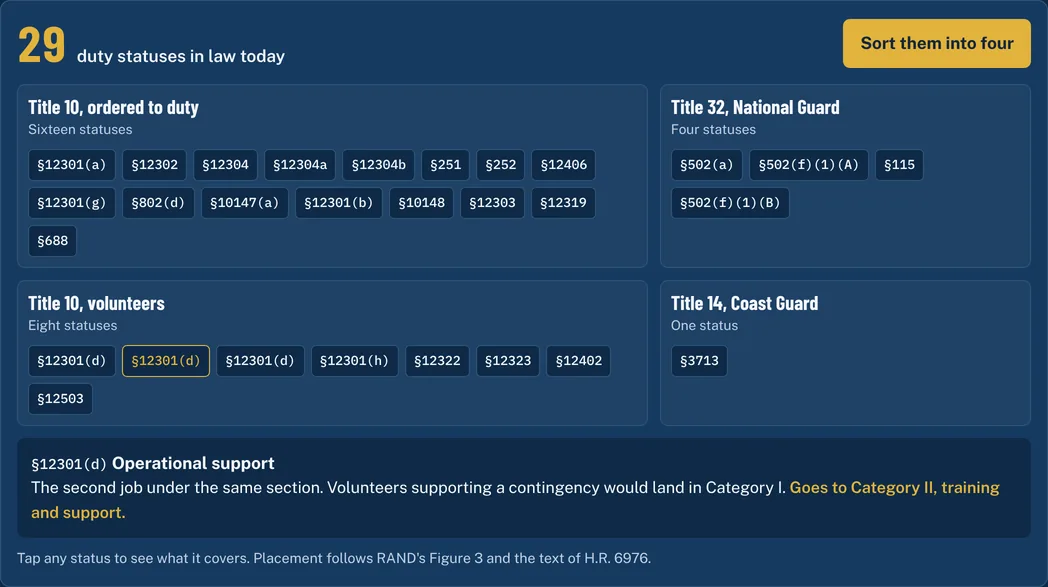
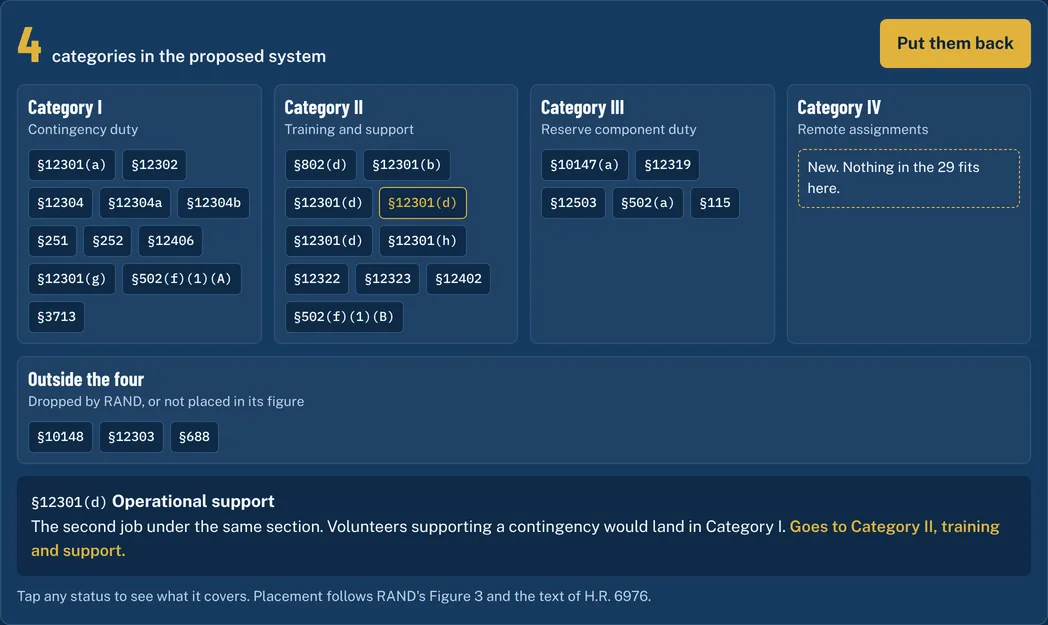
Before: About 29 duty statuses After: Four proposed categories
Situation
Congress has authorized approximately 29 duty statuses for Reserve Component members across three titles of the U.S. Code. H.R. 6976, introduced in January 2026, would consolidate them into four categories. AFSA and The Military Coalition both listed it as a priority.
Constraint
The same explanation had to work for two very different readers: an experienced officer weighing benefits and funding, and a new intern in a lawmaker's office seeing the system for the first time.
Decision
I didn't lead with the reform. I scoped a tool that first shows how the current system works, then adds a second view showing how much simpler the proposed change would be. The Duty Status Explorer opens on all 29 statuses and lets the reader sort them into four. Separate starting points are built for people who serve or served, people who lead Airmen, people who work on policy, and newcomers. It also lays out the trade-offs, including who would give something up.
Artifact
Two screens from the Duty Status Explorer show the same statuses before and after sorting.
Result
What I did: I directed the Explorer's build with AI, working from the bill text and the RAND report, then shared it with industry colleagues and Hill staff.
What happened: The reaction was positive. It helped staff understand a complex issue and run it up their chain more effectively.
The bill's status belongs to Congress, not to this tool, so I don't claim credit for it.
Reflection
Building the Explorer showed me how complex issues can be explained and visualized in easily digestible formats that help push legislation and ideas up the chain.